
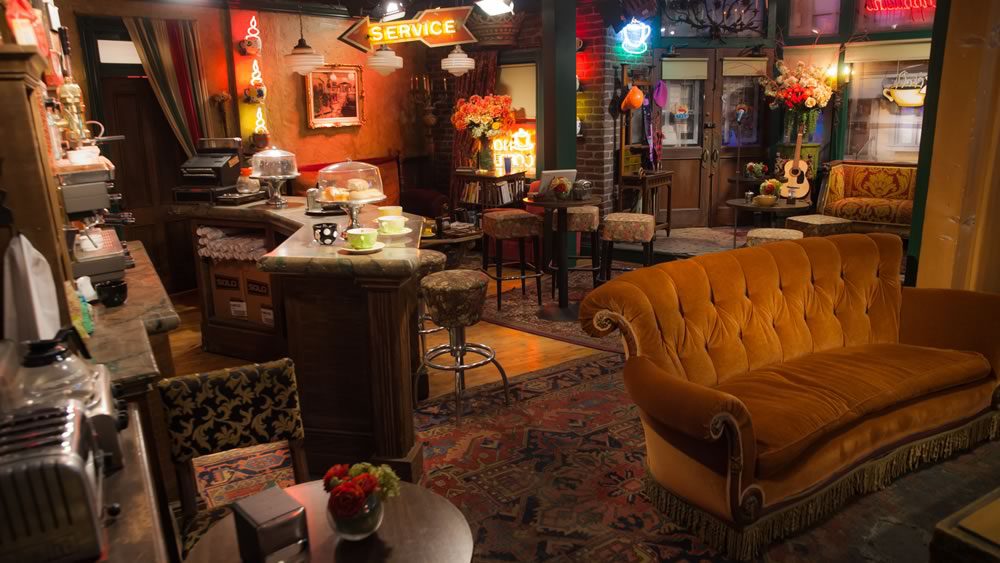
Who doesn’t remember theFriends, the beloved long running sitcom from 90s. The gang of friends passing their time in a Coffee Shop. This is a version of the coffee shop that exists only in cinema, and it is a beautiful, welcoming, luminous lie. In this version, the coffee shop is always bathed in warm amber light regardless of the time of day or the weather outside. There is always an open table — specifically a large, clean table by a large, clean window, with good natural light and enough space to spread papers, open a laptop, have a full conversation, and conduct what appears to be a small business meeting without anyone asking you to leave.
The queue, if there is one, takes approximately four seconds. The barista is charming and remembers the protagonist’s name and order. The coffee arrives immediately, it is perfect, it comes in a vessel that photographs beautifully, and no one spills it on anything important. The Wi-Fi works. There is a vaguely tasteful playlist at a volume that doesn’t compete with dialogue. The whole establishment has somehow been designed to facilitate exactly the kind of warm, intimate conversation that is about to unfold between two people who are either falling in love, solving a mystery, or having a crisis that will resolve satisfactorily by the third act.
The Actual Coffee Shop Experience
Real coffee shops are different. You join a queue that is longer than it appears because two people in the middle are splitting a complicated order and also asking questions about which oat milk the establishment uses and whether that matters for the foam. When you reach the front, you are asked your name, which you give clearly, and which will appear on your cup as something phonetically adjacent but emotionally distant from your actual name. You wait. The wait is not terrible, but it is long enough that you have to decide whether to hover near the collection point or try to find a seat first, creating a logistics problem that has no perfect solution.
The available seating, when you find it, consists of: a stool near the bathroom, half of a two-person table that is still technically occupied by someone’s bag, and a low armchair that is comfortable enough that you will be unable to work in it and will end up on your phone for forty-five minutes and then leave feeling vaguely guilty. The ambient noise level is high enough that you need headphones to concentrate, but you’ve forgotten your headphones. Someone at the table behind you is on a call. The person at the next table is also on a call. Everyone in this coffee shop is on a call except you.
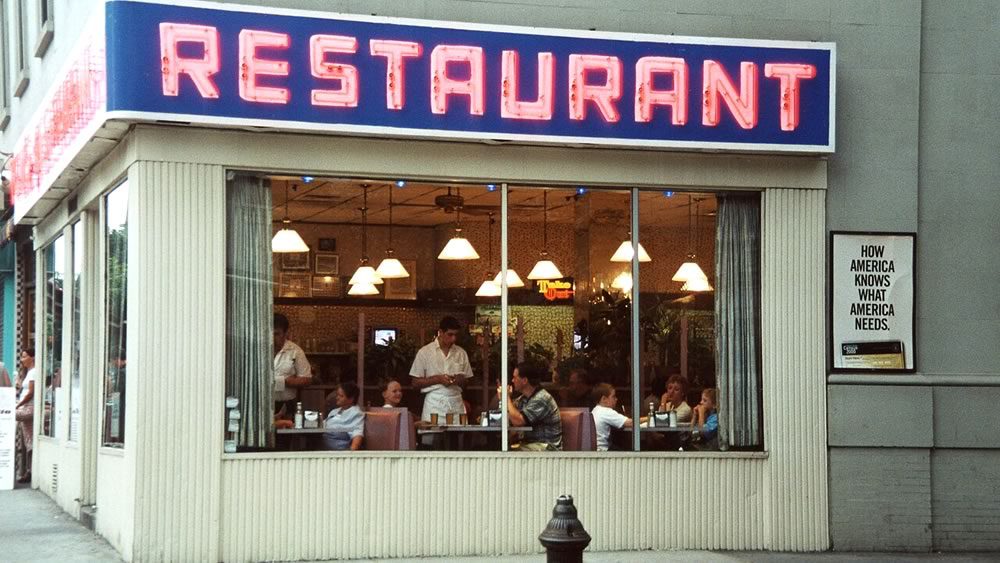
Famous as Monk’s in Seinfeld, and as Tom’s Diner, in the Suzanne Vega song of that name. This is actually Tom’s Restaurant, NYC – It is located at the northeast corner of W. 112th Street and Broadway in New York. Image by Rdikeman at the English Wikipedia, CC BY-SA 3.0, Link
Why Filmmakers Love the Fake Coffee Shop
The cinematic coffee shop is a narrative tool. It’s a place that feels public but operates like a private space — there’s ambient life around the characters, establishing that the world goes on, that other people exist, but the scene’s emotional focus is entirely inward. Nobody at the other tables interrupts. Nobody spills anything on the protagonist. The background figures are essentially human set dressing.
This kind of idealized public space is enormously useful for storytelling. It’s neutral ground — unlike someone’s home (intimate, loaded with personal context) or a workplace (hierarchical, professional). It’s warm and cozy but impermanent — you can leave at any moment, which adds subtext to every scene set there. Will they leave? Will they stay? Will they order another coffee, which is a small but legible sign that the conversation is going well? The coffee shop lets filmmakers manipulate all of this without having to explain it.
The cinematic coffee shop is not a place. It is a feeling — warm, available, always with parking, never too loud.
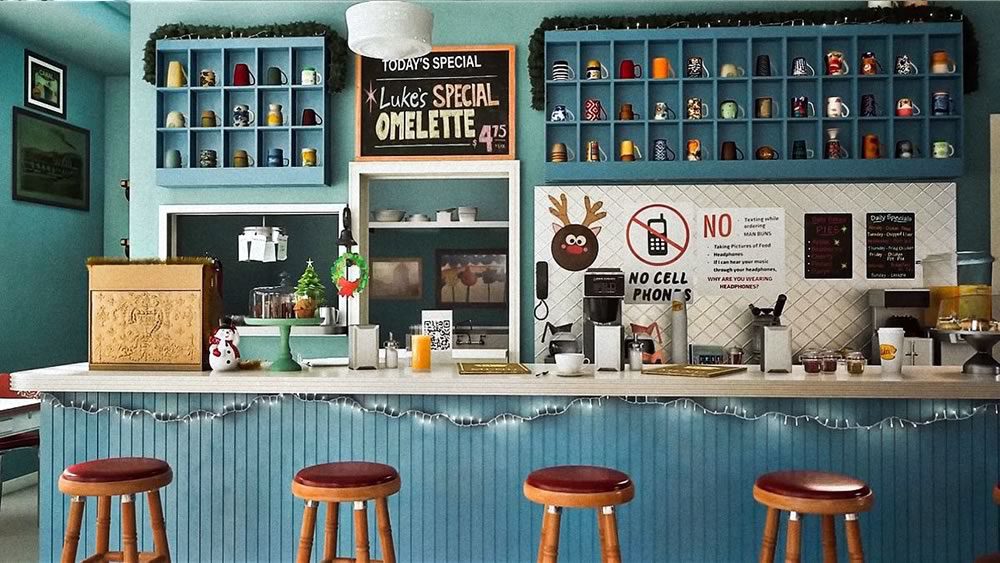
Luke’s Diner from Gilmore Girls (Images From Fatuconforti at Pinterest)
The Sociology of the Third Place
Sociologist Ray Oldenburg coined the term ‘third place’ in his 1989 book The Great Good Place to describe social environments that sit between home (first place) and work (second place) — the coffee houses, barbershops, pubs, parks, and community centers that form the connective tissue of social life. These places, Oldenburg argued, are where community actually happens, where conversations cross class lines, where strangers become neighbors. They are essential to civic health.
The coffee shop is the defining third place of the early 21st century, particularly in cities. And there’s genuine truth in the cinematic version — coffee shops do facilitate a certain kind of open, unhurried conversation that doesn’t happen easily elsewhere. They are genuinely good for a certain kind of thought. Plenty of books have been written in them. Plenty of relationships have started in them. The problem is simply the gap between the platonic ideal and the reality of the wobbly stool near the bathroom.
The Ritual That Keeps Bringing You Back
And yet. You go back. Every time. Not because coffee shops always deliver the experience you wanted, but because of the possibility that this time, today, on this particular morning, the window seat will be open. The queue will be short. The playlist will be exactly right. The coffee will be perfect. You’ll open your laptop and words will come easily. Someone interesting will sit across from you and say something unexpected. The morning will have exactly the quality that the movies always promised.
It doesn’t always happen. But it happens often enough. And that, really, is why the cinematic coffee shop isn’t a lie — it’s a highlight reel. It’s every coffee shop visit compressed into its best moments. Cinema just forgot to include the forty minutes in the queue.
REFERNCES
ldenburg, R. (1989). The Great Good Place: Cafés, Coffee Shops, Community Centers, Beauty Parlors, General Stores, Bars, Hangouts and How They Get You Through the Day. Paragon House. | Zukin, S. (2010). Naked City: The Death and Life of Authentic Urban Places. Oxford University Press. | Cowan, B. (2005). The Social Life of Coffee: The Emergence of the British Coffeehouse. Yale University Press.